Monday, February 1, 2016

An Early Birthday Present


She's sleeping as I write this. But she wasn't last night. I’m not sure what first triggered it, but recently Ivy has been waking up in the middle of the night with bad dreams. Last night, for the first time in as long as I can remember, Rachael heard her cries before me. She took the first shift. Ivy wasn’t quiet long before the tears started again and I had a chance to redeem myself. I popped up and stumbled into her bedroom. 

“I’m afraid, Daddy.” She says over and over again until I reach her. 

We pray together, and I’m surprised to hear her use complete sentences and better grammar than I’ve heard in earlier prayers and this at 1:30 a.m. Not bad. Her tears and cries return, and they are the real thing. 

She wails: “I’m afraid.” Then, standing, clutching at three stuffed animals, she asks: “Can I sleep with you, daddy?” In a former time, I may have relented at such a heart-rending request. But even in my midnight stupor, I know that kids in bed with parents does not a good long-term solution make.

“No honey,” I say. And the tears begin afresh.

“I’m afraid, Daddy.”

“What are you afraid of, sweetheart?”

“Scary monsters,” she says choking back sobs.

The other two who share a bedroom with her are awake now. Not that I expected to find them sleeping after Ivy’s siren-like outbursts, but I can detect the tell-tale signs. The steady breathing is missing. They shift subtly now and then. There was a time when the mere threat of waking slumbering siblings would have nearly unhinged me, but I am mellowing. That realization comforts me.

“I don’t want to sleep alone.” She continues.

Half-kneeling, half prostrate against the edge of her trundle, I begin singing “I Am A Child of God.” Ivy, the caboose of our five children, has a predilection for music. She can pick out a tune and retain it after hearing a song one time through. Music also sooths her more than it has our other children. Part way into the verse, she settles down. I sing all three verses partly for her, partly for me, and partly for the other two. Then, I crawl over her now relaxed form and lay beside her on top of her covers. I’m chilled, but the cool air feels good after the warmth of my bed.

Due to the lack of space and the preponderance of children in the middle bedroom, Rachael arranged Ivy’s trundle perpendicular to Grace’s bed above it. This way, the kids can hoard their toys and we can amass quantities of food storage under the now-vacant lower half of Grace’s bed. Additionally, because Ivy—almost Grace’s height—is still quite small, we can leave the trundle partially and permanently extending at right angles into the room from underneath the upper half of Grace’s bed. It also means that, lying next to Ivy, my knees nearly touch my ears.

Between the cool air from the window above and the contortions I’m forced to assume to fit beside Ivy, I know I will not sleep here. Fortunately, Ivy will. A few minutes pass and a soft rhythmic breathing issues from the bundle beside me. About the time I plan to stand up and return to my room, Carver suddenly, and without warning, springs from his bed. Without saying a word, he stumbles, jerky like, over to the edge of Ivy’s trundle. He towers groggily above us and I half expect him to collapse on top of us. He stops, wobbling still, and looks down to verify (I assume) that I am in Ivy’s bed. Confirming my presence, without a word, he totters back to his own bed.

“That’s my cue,” I think. After waiting for another minute or two to ensure that Ivy truly sleeps, I crawl out of the trundle, kiss Ivy on the cheek, touch Carver’s head gently on the way out, and navigate the darkened rooms back to my bed. Before slipping in next to Rachael, I kneel and pray that Ivy will feel comfort. It occurs to me that she’s right to be afraid of monsters. I consider myself an optimist, but there’s no denying a fair number of monsters inhabit this world. I trust that my Father watches over this family.


As I rise from my knees, I think: “How would I capture this experience if I were Michael Perry.” The words, the phrases, and thoughtful forms of expression all come easily to mind right now at a quarter to 2:00 a.m. “It won’t be so easy tomorrow morning,” I realize as Rachael sighs gently, I shift a few times and remember nothing else until 5:00 a.m.

Friday, January 22, 2016

Today: Eyes to See


Sixteen years ago last month, we met. She thought she needed help with Spanish. She could not see her strength. Could I?  

I see her now. She is running on my desktop. She’s running up a hill into the rising sun. The early morning sun electrifies the horizon mist washing out and blurring all distinction in a fiery glory. She runs resolutely, steadily toward that glory. Acceptance or hunger, which of you draw her onward? Already she’s 100 feet ahead of me. Will I ever catch her?

Is it the rain, the rain that fruitlessly yet incessantly and unyielding in its efforts to pierce my glass barrier and staunch the warm drive within, is it this rain that tempers my heart? That gives rise to the tremulous thoughts of stumbling and slipping into solitude? And what do I do with these thoughts? Do I embrace them and wallow in their stickiness? Do I reject them and heedlessly proceed knowing in Whom I trust?

He comforts me. He reminds me that her constancy runs deeper than my fears. Her depth, like the stamina on which she draws to run that hill and pull away from me, humbles me. How do I complement someone so strong in so many ways. She forgives when in my calloused pride I fail to recognize my offense. She absorbs the manifestations of my pain. Somehow, miraculously He helps her recognize the pain of others. And she listens while she runs. She can hear Him. She absorbs the pain of so many.


Wilt Thou extend to me Thy strength? I want to reach that hilltop with her. I imagine the fire. I imagine the message. I too want to hear. Can I absorb and deflect with equanimity as she does? I hunger for this. My knees and chest ache. My strength alone will not get me up this hill. Wilt Thou share Thy strength? 

Tuesday, May 5, 2015

Tiger Mountain on The Trance

Shortly before losing my front fender on Tiger in early April.

I’m getting this post up a little late, but it’s going up! Or so help me. Now that Tiger is open year round (with a few exceptions) and with all the crazy weather we’ve had this year, we were able to ride Tiger in mid-February. 

Dry and green at 3,000' in mid-February
Just finishing the "Fully Rigid" section of the trail in February.

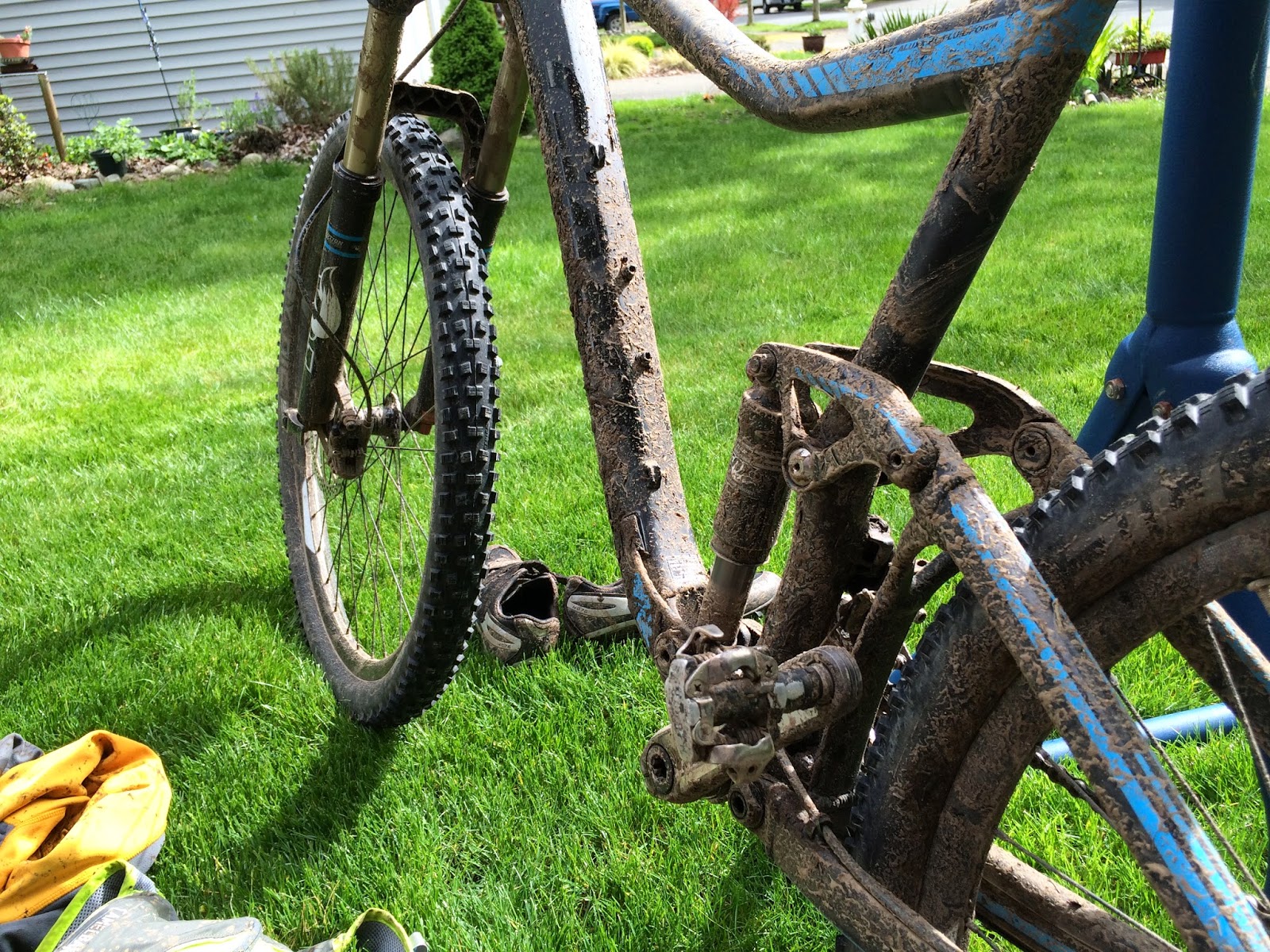
And when we rode in February, the sun shone and the trails were dry. Last Saturday, April 25th, I decided to ride Tiger again. I had some "churchy opportunities" to attend to in the mid-a.m. hours. So I wound up hitting the trail around noon only to be greeted by torrential hail and snow. I plowed my steed through the slippery, snotty mess from the Peak to the parking lot at the pass. And in the process, the bike and my gear absorbed several pounds of mud in the descent. Clean up took a while. Some of my bike gear will carry Tiger Mt. detritus indefinitely.

This was not actually taken the day of the subject ride.
But conditions were identical on April 25th. 

Coming off a '06 Stumpjumper and an '07 Giant Anthem 0 (both of which rode on 26's), I will say that I was a little concerned that the Trance was just too much bike: too heavy and too much travel. I don't wonder that any longer. The Trance handles so well on the mountain. It took me a few corners to get familiar with the stretched length of the bike (as compared to my older full-suspension bikes and my two 29ers - which are hardtails and so a little shorter). But now, I appreciate the increased stability at speed, the longer suspension, the relaxed geometry and wider handlebars. 


On a side note, I have not been pleased with the brakes—of the Shimano Deore variety—on the new Giant. Very spotty performance: lots of brake drag, noticeable brake fade, and periods of no pressure. While pumping the fading lever usually does the trick, you never want to grab an fistful of emptiness when you reach for the skids while descending Tiger at speed. So the question now is: Will a brake bleed correct all the bad behavior? I think probably not. Having ridden Avid's from the beginning of the disc brake revolution, I had assumed that the Shimano brakes performed better. 

In any event, the weather has been very different this year. So far the warm weather has baked and dried our usually sloppy, west-side trails to August levels in May. I can't imagine that we're not going to pay for it in some way this summer, but happy trails until then.   


Tuesday, December 23, 2014

Today: Ruminations on rigid steel single-speeds, full-suspension bikes, and 29" wheels


Well, I did it. I finally got back on the steel stallion. And two very good things happened. Not only was it absolutely therapeutic to ride again, for the first time since the lung collapse three weeks earlier, but I was reminded how much I love the single speed. On occasion, when the opportunity presents itself, I pull my Redline Monocog 29er off the garage wall and kick around some of the local trails. My dad offered me the bike last November, which is a different story. At the time, I was skeptical and thought if I didn’t like the bike—and I assumed I wouldn’t—that I would just trade it in for credit at Recycled Cycles.

During last year’s gray November and early December days, I trail tested the Monocog. After that maiden voyage, I struggled to understand why anyone would ride single speed or rigid. The gearing felt tall especially on the climbs. The trail feedback left me achy and sore. But I kept with it. Actually, because I was lending my other bikes (the Giant Anthem and the Specialized Stumpjumper) to the objects of my cycle evangelism at the time, I spent a lot of time riding the single speed. This worked well because it allowed me to better equip the newbies for success by lending them the forgiving full-suspension bikes. And I loved it because the challenge of riding a fully-rigid single speed allowed me to stretch myself physically even though we were riding at a slower pace than would have otherwise represented exercise.

I learned or relearned a very interesting lesson over those first few months. Arms and legs will suspend a rider just as effectively as full suspension provided the rider rides in a standing mode. Riding in standing mode, also addresses the gearing element. The extra torque coming from a standing compensates for the lack of gears. What is interesting to me is that I can ride just as fast—if not faster—on the tight windy, Western Washington trails, as I can on any of my bikes. It’s just a different style of riding. Riding full-suspension works best in the saddle. Riding rigid and single speed is best in the stirrups. I will say this about the single speed, I do notice that my arms are far more fatigued at the end of a jaunt on the single speed then even on my hard tail. One time last year, near the end of a ride, my hands just let go, launching me over the bars and into a berm on the downhill side of a small rise.
 
I recently gifted my Stumpjumper to a good friend. And the longer I go without a full-suspension bike, the more I wonder about the legitimate application of any full suspension ride outside gnarly downhill or long-distance cross-country setting. And even that may not be entirely accurate when you consider that I have ridden Tiger Mountain and my longest cross-country rides more often on a hard tail than astride a full-suspension bike. When you roll the 29” wheels into the mix, it may just be that for my style of riding a full-suspension bike may no longer be necessary. But that doesn’t mean I don’t still lust after some fully-suspended goodness!

Sunday, November 23, 2014

Today: Minor Chords


Over the years, I have experimented with the guitar. I love music, more to play it or to sing it than to listen to it. Not that I can do either. Because I can't. Still, it bothers me a little that as a society we have outsourced music to artists and musicians and thereby effectively cut ourselves off from what I feel is a key source of peace and an effective tool for coping with the challenges of life.

I began my flirtation with the guitar during high school. And while I harbored a sincere interest in giving expression to the feelings within my soul, my primary motivation for learning the guitar may have been a desire to impress members of the opposite sex. Perhaps due to lack of viable prospects on that front, this flirtation never really matured into a full-blown romance. In fact, some years later, following my mission, I sold my guitar for $50 in order to facilitate the purchase of bike parts. Even now that feels a little sacrilegious.

Fast forward a decade and a half, amidst the gloom of another Seattle winter, I realized I needed some sort of distraction. Mike Ward, a good friend and a consummate musician, lent me a guitar and some good advice on self-directed learning.

It didn't take long before I was back at the same mediocre level I "achieved" during High School and not truly advancing anywhere. The challenge for me is choosing to make time to improve, that and trying to learn strumming patterns and chords from YouTube. As they used to say in el campo misional, this approach to learning an instrument is menos eficaz.

Most nights my guitar sits beckoning in the alcove upstairs. And so with absolutely no understanding of music theory and little to no direction, I remain a three or four-chord wonder. Really, I have pretty much mastered G, C, and D, which suits me just fine because I’m a major chord kind of guy. 

Not so long ago, Rachael and I were discussing a song she liked. I remarked how I really didn’t like the sound of the minor chords in the song. Granted, I am not really sure I know what a minor chord is. Recognizing this, Rachael spent a few minutes futilely attempting to explain the beauty of minor chords in terms that someone with my unsophisticated musical sensibilities could understand.

Finally, still searching for expression, she just said, “I love them because they are meaty. I can sink my teeth into them.” The conversation moved on, but that phrase hung in the air for a few days. I ruminated on its significance and let it simmer on the crowded backburners of my mind.


A short time later we watched the movie The Hedgehog, based on the New York Times best-seller, The Elegance of the Hedgehog by Muriel Barbery. In her fictional account, Barbery masterfully weaves humor and profound kindness into an underlying tragic plot ultimately ending on a transcendent note. It kept us talking for days. Ultimately, we realized that, like minor chords, here was a movie into which we could “sink our teeth.”

Following those two experiences, Rachael and I began to detect “meaty” or “minor chord” experiences all around us. Last night, after my second full day in the hospital and with at least two more to go, my folks offered to take the kids home so that Rachael and I could talk by ourselves for a few minutes.

My children are very good children, but the sheer number of bodies combined with Carver’s so-called “special needs” and Ivy’s . . . personality . . . age . . . something (?), rendered this undertaking no small task. The kids loved it. Grandpa treated them to McDonalds. Rachael and I just sat and talked with no distractions. No food, no dishes, no vacuum, no mess (but the hose in my side), no clothes to fold, just the bubbling of my chest drain and two friends becoming reacquainted. Around 8:00 p.m., when she left, Rachael turned in the door to say ‘good-bye.’ This was a “minor chord” moment. It hurt to see her go.

Earlier in the day, when I could stand the solitary confinement no longer, I wandered down the halls chest tube dragging, hospital gown waving. In nearly all the rooms around me, lay individuals usually older and far worse off than I. Since emerging from emergency room, I have received a near continuous string of well wishes by text and e-mail. I have even received visitors a few times. 

To say that this hospital stay is a bummer, would be a gross understatement. Beyond the inconvenience of being separated from Rachael and the kids for a few nights or missing a weekend with my parents, this experience potentially represents the opening of a new, less-active chapter in my life.

With the probability of recurrence very high, my ability to endulge in coping activities like mountain biking, backpacking, and running appear very much at risk. On top of that there is the looming financial burden associated with my protracted stay in Hotel Valley Medical.

And yet, the kindness of friends, the opportunity to receive service, as much as I hate being the object of the service, tempers all this bitterness. Earlier this morning, I wrote the following in my journal: "I am so grateful for this experience and the depth and the richness it brings to life. I can’t truly explain it all. Beauty isn’t all about pleasure and happiness. Beauty is found in texture and struggle." Minor Chord experiences make life more complete. They enhance the good times and lighten the dark times.  

Saturday, November 22, 2014

Today: Hospital Gowns, Law School, and Accidents


At the time of this writing, it has been almost ten years since I graduated from law school. That’s long enough to forget a lot of things, including many of my feelings about the day to day experience. I will say, however, that as I remember it, law school was generally a very happy time for our family. We didn’t have much in terms of means, but we had enough, we had good friends, we were centrally located between our families, and more than anything we had the promise of the future to motivate us. The older I get, the more I believe that true happiness is a function of hope and promise and less a function of the circumstances through which one is passing.

I sit here “festooned,” as it were, by a drafty hospital gown on a grey metal folding chair in a drab hospital room. It is a room like all hospital rooms I have visited—pink on grey cabinentry, stainless steel accents fluorescent light, hard laminate flooring—with one difference: I’m the one stuck in it. I do have company though. On the floor at my feet, ever bubbly, my vigilant chest drain chatters away. And of course, I feel inseparably connected to my new traveling companion: a half-inch diameter hose protruding from my side.

 
I suppose if I dwell on the situation too long, it might begin to feel a little like solitary confinement. But of course, that isn’t fair. The nurses visit me all the time, even in the middle of the night! No, life is good. In fact, this experience reminds me a little of law school.

The law school environment has a great deal to offer. The way I see it, if you surround yourself with distinguished professors and accomplished cohorts, you can’t help but have an exhilarating experience. Granted, at least in my case, that exhilaration mostly originated from the knowledge that I was in way over my head.

Even with all the "exhilaration," there were times in the middle of every semester where the coursework simply lost its luster. Yes, there comes a point, perhaps in any endeavor, where the days seem to roll indistinguishably together. No one can escape that, not even in the ivory tower. I’ve been feeling a little that way of late. I’m just itchin’ for a change, a move, a new challenge something to shake things up a little.

That brings me to Tom (not his true name), one of my closest friends in law school. (The fact that he chose to befriend me speaks volumes to his charity and kindness.) Anyway, Tom remains one of my favorite kind of people. Well-grounded in the faith, he shouldered heavy responsibilities in his ward while going to law school and raising a growing family. A life-long resident of Utah, Tom participated in a variety of hardy outdoor sports. He ran like a Carl Lewis. He was a backpacker, a mountain climber, and a skier of the telemark variety. With all that to keep his attention outside, Tom clearly preferred the outdoors to the classroom.
 
Not that he was a slouch academically. Tom consistently scored at the top of the class for all three years. He came to law school having pulled down a difficult degree in Philosophy. Very sharp in all respects.
 
Both Tom and I chose the Thinkpad A31.

The J. Rueben Clark Law School required that each student purchase a laptop. I suppose the administration expected that we would use the laptops to take notes and complete exams. As it happened, the year I began law school was the first year that the law school offered wireless internet throughout the building. Of course, this advent led to all sorts of unintended malarkey. People played online games and read the news. Some used instant messaging to slip answers to students getting grilled by the professors as part of the Socratic method.

Tom took school seriously and apart from reading the news occasionally left the interwebs alone. He did have one guilty pleasure, however. A true mountaineer at heart, Tom used Summitpost.org and the avalanche reports as a literal window to the outside world during class. Because the wireless could be a little spotty in the classrooms, Tom would open up a dozen or more instances of his browser each one focusing on a different peak, minimize the windows, and then—as if methodically eating an orange—slowly tick through each one over the 50-minute period.

 
The J. Reuben Clark Law School sits on the eastern edge of BYU’s campus. At least when I attended the school, Heritage Halls (on-campus housing for first-year students) was situated immediately to the north of the law school. A little farther up 900 E., still heading north, were Deseret Towers (long since gone and the married student housing). After that you’d come to the MTC and the Provo Temple.


Tom moved his family to the on-campus married housing part way through our law school experience. This made it possible for Tom to leave their white Buick LeSabre at home. Instead, Tom would coast his ill-fitting older mountain bike down the long sweeping hill from the Temple and married housing past Heritage Halls and onto the law school campus. Obviously, the trip home was a different kind of experience. After all, what goes down, must come up . . . ? 

So anyway, one day during our third year in the school, Tom came in looking a little more tired than usual and perhaps a little stiff. Out of habit, I asked him about his evening. He then proceeded to tell me how he had been hit by a car on the way home from school. Tom had been riding his bike past the Heritage Halls parking lot when a young, student plowed into him with her car. She hit him so hard that he rolled up on to the hood of the car and the bike was damaged.

I sat there completely dumbfounded. My jaw ajar, I looked at him trying to find any indication of trauma. Nothing. Tom wasn’t one to show emotion. He had a sheepish grin on his face when he told me, “All I could think, when she hit me, was ‘finally something exciting is happening to me!’” Words to live by from a wise man who has gone on to accomplish great things.

I’ve thought about those words a lot over the years. Today, as I sit in the hospital and stare out at the dripping soggy bleakness and contemplate another day of inactivity followed by a long recovery, it could be easy to mope a little. But I don’t feel that way. Yesterday, as the Urgent Care doctor—clearly enjoying something a little different—explained his diagnosis to a room full of nurses and two very engaged medic teams, Rachael turned to me and said: “Finally, something exciting is happening to us.”
 
And you know what? I was thinking the same thing. That is, at least before they carted me off to the A-car. Trouble is, I never thought to ask Tom—all those years ago—if “something exciting” was supposed to be a good thing or not.

Monday, November 17, 2014

A Revisionist's History: I Will Fly


All that talk about the Grand Caravan reminded me a little of a different vehicle: the Plymouth Volaré! I contend that the Volaré—the down-sized Chrysler station wagon of the post-embargo era—is the spiritual predecessor of the Grand Caravan. Both vehicles were designed and manufactured to more effectively haul families and gear. Both vehicles, once reaching a certain mileage, wound up among the ranks of service vehicles littering constructions sites and industrial parks the nation over. Not that this can be proven, but I have my reasons for believing it.

 
Before leaving on an LDS mission with my Grandmother in the late 80’s, my grandfather sold dish soaps and supplies to restaurants, bars, and other roadside eateries sprinkled throughout Southeast Idaho and Western Wyoming. Most summers growing up, I would spend a week or two living with Grandpa Howell in Idaho Falls, or in later years, Boise. During those early years, when Grandpa stilled lived in Idaho Falls, he would often take me with him as he ventured to scenic locales like Bone, Ririe, Swan Valley, Jackson, and Driggs. I don’t remember much about these trips. But I do remember a few things. . . .

One time grandpa bought me a sandwich at a convenience store. Still naïve enough to believe that all prepared food you pay for must be good, I consumed more than half before Grandma Howell pointed out that my sandwich was moldy. Grandpa Howell insisted the green moldy flecks were "spices." As I recall, I finished the sandwich. One time as Grandpa Howell maneuvered through a windy, dirt, “short curt” through the mountains, the car rolled a little too closely to the edge. While Amy and I stared on with mixed horror and fascination, Grandma Howell came to the rescue vocally expressing her concern.
 
The one common thread through all these experiences and many others was the Plymouth Volaré station wagon. Over a period of several years, I remember Grandpa Howell driving both a Plymouth Volaré station wagon (complete with faux wood paneling) and a Dodge Aspen sedan (a badge-engineered twin to the Volaré). I traversed many a mile ensconced in their luxurious, vinyl-swathed appointments.
 
As a career, soap salesman doesn’t rank high on the relative compensation scale. No doubt with an eye to supplementing income, Grandpa Howell would often bring home his clientele’s discarded commercial dishwashers. He would clean ‘em, repair ‘em, and resell ‘em to his clientele. Even as a boy, I admired that. At least until he would ask me to detail the stainless steel dishwashers with an S.O.S. pad in the driveway. What was truly impressive though was his ability to shoe-horn those dishwashers into the back of the Volaré. Somehow, with the tailgate up, the cavernous maw of the Volaré managed to swallow the dishwasher. I want to say that Grandpa also strapped a dishwasher to his handy, chrome-plated roof rack, but that may be entirely fictional.  
 

Born in 1929, my grandpa was the product of the depression—as if that were not already immediately apparent. Resourcefulness, pragmatism, and frugality, these things ran deep in Grandpa Howell. To carry the family through the tight times or perhaps to free up valuable income, Grandpa used a sledge to crack the concrete pad in his garage. Then he excavated a potato cellar beneath the floor, covering it with an oil-stained piece of plywood to prevent an unintended trip into the inky blackness below.

 Only once did I manage to muster the courage to descend into the pit. The cool, the dark, the moist and a spare patch of relatively bright light from the cobwebbed garage window above left a clear impression on my young mind. I vaguely recall that the potato farmers in Grandpa’s ward or stake would allow members of the Church to harvest the potato “remnants.”

I’m still not sure how I managed to swing this, since potato harvest was usually in the Fall, but I once joined Grandpa on his potato harvest. Lending the whole event an air of near criminality, all this went down at dusk. Again, reaching back into the dustbin on this one, I remember Grandpa driving his Dodge Aspen, the sedan, out into the fields. We filled the trunk and the entire backseat with potatoes. It was a stupefying volume of the potatoes. It must have weighed several hundred pounds. By the time we finished it was dark and light from the dome-lamp spilled out onto the dry dusty field. Staggering beneath the load, the Aspen’s wheels sank into their wells while the headlights shone skyward as we bounced back to town.
 
I’m not sure if there is a moral to this story. But, I will say that if any man ever deserved a pickup (before the age when the pickup became America’s best-selling vehicle for 30 years running), Grandpa Howell was that man. As the owner of a 20-year-old anemic Nissan pickup and the former owner of a Dodge Grand Caravan, perhaps I inherited an ounce of Grandpa Howell’s Depression-era Good Sense.